



As a dietitian who knows the ins and outs of dietary supplements, I have never had more questions about heavy metals than I have over the past week. You may have heard about it recently, too, due to a new article published by Consumer Reports called “Protein Powders and Shakes Contain High Levels of Lead”. This has caused a lot of media attention, social buzz, and quite honestly…confusion. And I get that. Supplements are confusing on a normal day, let alone when a million people are weighing in on a topic that requires nuanced discussion.
While the headlines may sound alarming, the truth is that trace amounts of heavy metals occur naturally in virtually all foods, including vegetables and fruits. What matters most is how much is present and whether a product meets trusted safety limits. So before you toss out your tub of protein powder, let’s get into the facts.
What You Need To Know:
- Bottom line? Don’t panic. Whey protein goes through several filtration steps and products are tested for heavy metals at various stages in the manufacturing process to ensure they are safe and don’t contain high levels of contaminants.
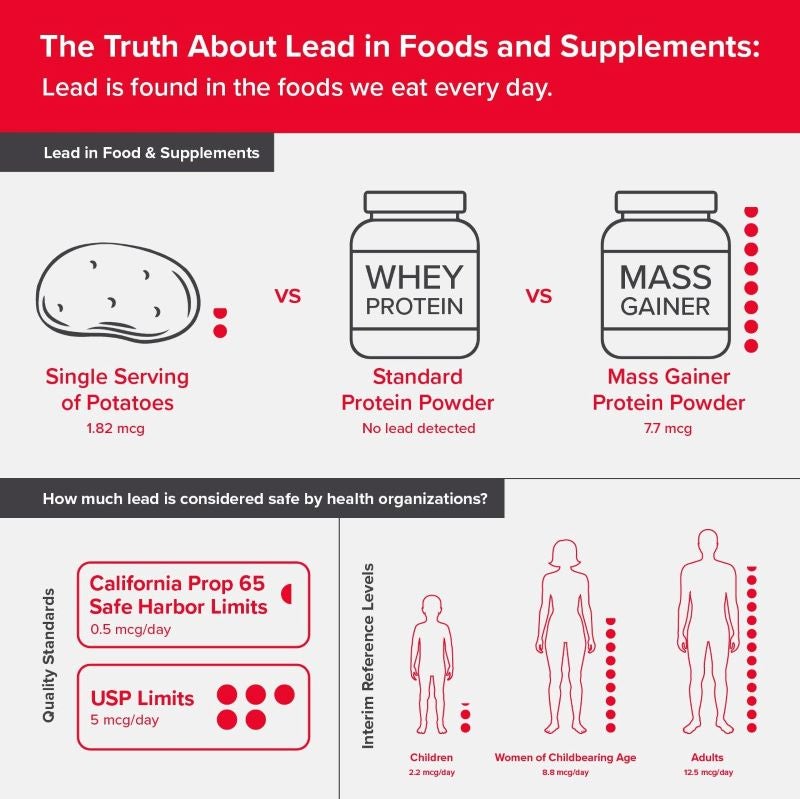
- Heavy metals like lead, mercury, cadmium, and arsenic occur naturally in the environment and in the food we eat every day.
- Consumer Reports recently published test results evaluating the lead and heavy metal content of protein powders and shakes. However, the limits were based on a very low and restrictive amount of heavy metals established by the state of California.
- All GNC branded proteins are rigorously tested and meet or fall below U.S. Pharmacopeia (USP) safety standards, which allow up to 5 micrograms of lead per daily serving.
- Generally speaking, protein powders are very clean options when it comes to heavy metals. Most of the products that tend to test higher are plant-based proteins (because of the naturally occurring metals in soil), mass gainers (because of the high dose), and chocolate flavors (because of cocoa).
What did Consumer Reports find?
Consumer Reports, a nonprofit organization that prioritizes transparency for consumers, conducted testing on 23 of the most popular protein powders and ready-to-drink shakes. Results found that about 70% of the products contained levels of lead “over 120 percent of CR’s level of concern for lead, which is 0.5 micrograms per day”. Products were then categorized as products to avoid, products to limit to once per week, okay to take occasionally, and better choices for daily consumption.
Is there lead in protein powder? Are protein powders safe?
Yes, there is lead in protein powder, but not for the reasons you might think. Trace levels of heavy metals like lead, cadmium, and arsenic occur naturally in many foods, including vegetables, grains, and fruits. They’re present in the environment and can be absorbed through soil, water, and air. This means even clean, high-quality protein powders may contain very small amounts.
To further ease your mind…a 2020 publication in Toxicology Reports found that the typical intake of protein from dietary supplements does not pose an increased health risk due to the presence of heavy metals. The products on the “higher end” were mass gainer powders. This makes sense because the dose of mass gainers are high, requiring upwards of 6 scoops per serving. More scoops means more protein, and all the ingredients that go with it [6].
How much lead and heavy metals are considered safe?
This is where things become nuanced. The answer is: It depends what you’re basing the levels on. Essentially, there are three organizations that provide guidance for heavy metal limits, such as lead, arsenic, cadmium, and mercury.
- FDA Guidance: In the United States, there are no federal guidelines for the amount of lead that adults can safely consume through the diet. Instead, the FDA has developed Interim Reference Levels (IRL) for children and women of childbearing age. IRLs are just estimates to use as a benchmark and are not an official regulation. The IRL for lead is 2.2 mcg per day for children, 8.8 mcg for women of child-bearing age, and 12.5 mcg for the general adult population.[1,2]
- USP Guidance: For the pharmaceutical and supplement industry, a common standard for finished product testing is the United States Pharmacopeia (USP) limits for heavy metals. The USP limit for lead is 5 mcg per day[3]. The NSF/ANSI 173 is another standard used and applicable to foods and supplements, and some companies use their standards for testing heavy metals. For example, the ANSI limit for lead is 10 mcg per day[10].
- California Proposition 65: The state of California has a regulation known as Proposition 65, which requires warnings on product labels indicating the product contains ingredients that may cause reproductive harm. California’s Prop 65 limits for heavy metals are much lower than what’s allowable by USP. For example, the Prop 65 limit for lead is ten times lower than the USP limit (0.5 mcg vs 5 mcg)[4].
It’s also worth noting that heavy metals occur naturally in the foods we eat every day. A study from 2018 evaluated the heavy metal levels of the five most-consumed vegetables in the US: lettuce, potato, carrot, tomato, and onion. Results showed that many of these common veggies contain more heavy metals than many of the protein products listed in the Consumer Reports article[7]. Shocking huh?
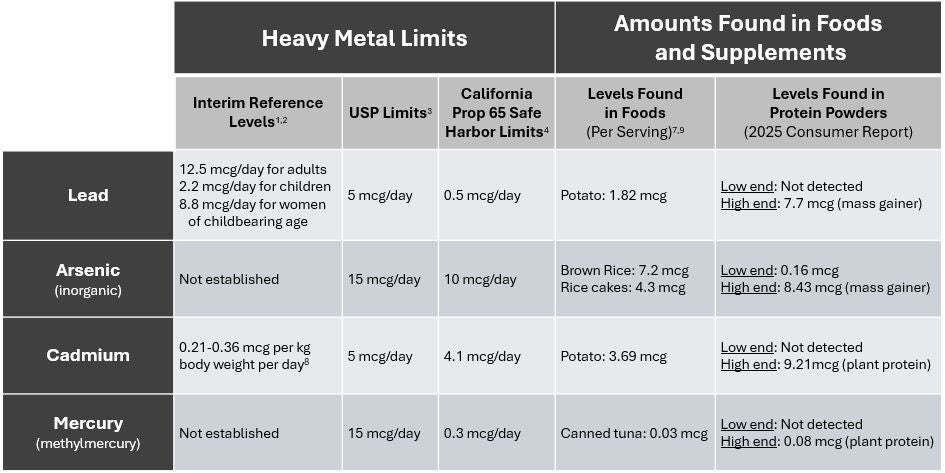
To help compare apples to apples, below is a chart that outlines the limits for heavy metals as established by health organizations, the amounts found in a serving of common foods, and the amounts found in protein powders. If you’re wondering, “How much lead is in my protein powder?” Here’s one way to understand it: You would need to drink eight servings of our GNC Pro Performance 100% Whey protein to match the amount of naturally occurring lead found in a single serving (85g) of lettuce.
Comparison of Heavy Metal Limits and Amounts Found in Foods
GNC’s Protein Powder Safety Measures
Testing
- For GNC branded products, we test every batch of raw ingredients for heavy metals like lead, arsenic, cadmium, and mercury. Our finished products (including whey, casein, and plant-based proteins) go through additional testing to confirm they meet or fall below safety limits established by the United States Pharmacopeia (USP) and other regulatory bodies.
- If any GNC products (including protein) contain levels of heavy metals above the levels established by California Proposition 65, they will receive a warning on the product label. However, it doesn’t mean the product is unsafe. Many of the chemicals that are on the Prop 65 list occur naturally in the foods we eat every day. Many companies produce separate packaging for California products, but GNC only uses one label and provides the Proposition 65 warning to all consumers for an added layer of transparency.
Manufacturing
- All our manufacturers are audited by our quality team as well as the FDA and other 3rd party auditors to ensure that they are following the Good Manufacturing Practices (GMPs) as part of the code of federal regulations.
Third-Party Testing
- GNC’s products are regularly screened by ConsumerLab.com. This program involves verification of parameters such as: nutrition/supplement facts panel, lack of heavy metal contamination, “Free from” and “No” claims, etc. and is another way that GNC’s products are being monitored for purity and quality by third parties.
- Many of GNC’s products bear the Informed Choice certification logo. This rigorous testing program is another level of reassurance as to the purity of our products. This program includes a thorough product and manufacturing review, which involves: quality systems and audits, staff training, raw material review, raw material supplier assessment, and traceability & recall procedures.
Tips for Choosing a Protein Powder That’s Lower in Heavy Metals
- Look for third-party testing, such as Informed Choice, NSF, and Consumer Labs
- Choose a dairy-based protein powder, which tends to have lower levels of heavy metals compared to plant-based protein powders
- Keep an eye on flavor. Cocoa, the common ingredient in chocolate, tends to have more lead than flavors like vanilla.
- Avoid products with California’s Prop 65 warning. While the level of lead and heavy metals that trigger this warning are extremely low, it is one way to weed out products if you’re concerned about it.
A recent article by Consumer Reports has been in the headlines about protein supplements testing high for lead. While this may seem concerning, it’s really nothing to be worried about. Lead is found in the foods we eat every day and the amounts found in nearly all of the products are considered acceptable by various health organizations. GNC’s commitment to quality ensures that the ingredients in GNC branded products are tested for heavy metals, so you can ensure what you’re putting into your body is safe.
References
- Brenna M. Flannery, Karlyn B. Middleton. Updated interim reference levels for dietary lead to support FDA’s Closer to Zero action plan. Regulatory Toxicology and Pharmacology, Volume 133, 202. https://doi.org/10.1016/j.yrtph.2022.105202.
- Dolan LC, Flannery BM, et al. A review of the evidence to support interim reference level for dietary lead exposure in adults. Regul Toxicol Pharmacol. 2020 Mar;111:104579. doi: 10.1016/j.yrtph.2020.104579. Epub 2020 Jan 13. PMID: 31945454.
- United States Pharmacopeia. Section: Elemental Impurities Limit. c232-usp-39.pdf
- Proposition 65 No Significant Risk Levels (NSRLs) and Maximum Allowable Dose Levels (MADLs). Proposition 65 No Significant Risk Levels (NSRLs) and Maximum Allowable Dose Levels (MADLs) – OEHHA
- Lettuce, iceberg, raw – Nutrients – Foundation | USDA FoodData Central
- Bandara SB, Towle KM, Monnot AD. A human health risk assessment of heavy metal ingestion among consumers of protein powder supplements. Toxicol Rep. 2020 Aug 21;7:1255-1262. doi: 10.1016/j.toxrep.2020.08.001. PMID: 33005567; PMCID: PMC7509468.
- Hadayat N, De Oliveira LM, Da Silva E, Han L, Hussain M, Liu X, Ma LQ. Assessment of trace metals in five most-consumed vegetables in the US: Conventional vs. organic. Environ Pollut. 2018 Dec;243(Pt A):292-300. doi: 10.1016/j.envpol.2018.08.065. Epub 2018 Aug 27. PMID: 30193223.
- Cadmium in Food and Foodwares | FDA
- U.S. Food and Drug Administration Analytical Results from Inorganic Arsenic in Rice and Rice Products Sampling September 2013. download
- NSF/ANSI 173 Dietary Supplements Product Certification Standard. PowerPoint Presentation
Find more articles here.

