


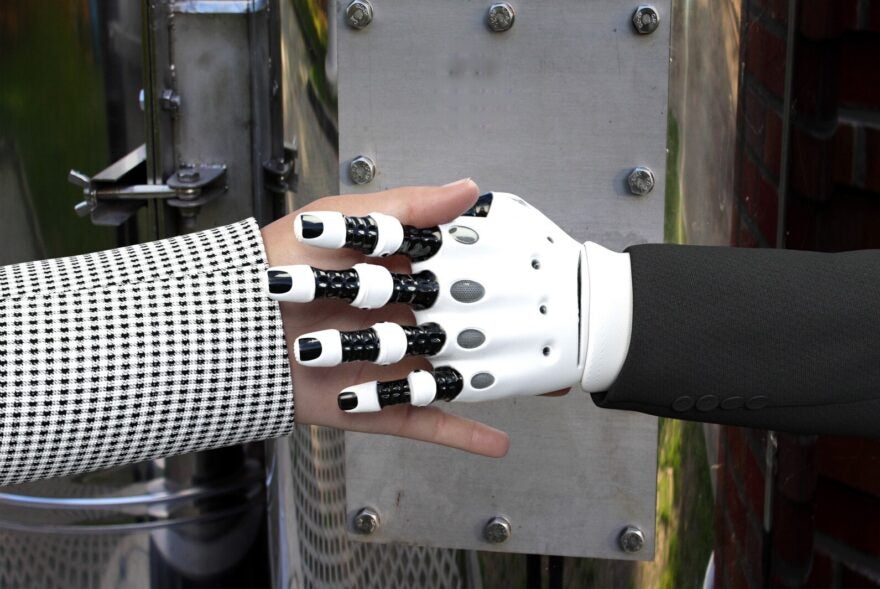
Imagine a not-so-distant future where artificial intelligence (AI) is helping you and your healthcare provider manage and optimize your health. A doctor’s visit may involve initial intake by a human-like robot that will ask you health-related questions. The robot is then able to analyze your concerns by cross-referencing them with a vast network of medical knowledge.
Once the doctor arrives, the robot has already come up with multiple possible diagnoses, created evidence-based treatment plans, and ordered your necessary prescriptions. All your provider needs to do is review the recommendations made by AI and you are on your way.
This synergy between AI and human practice is likely the future of healthcare. The goal of partnering with AI will be to improve efficiency and access to care while reducing human errors. Experts are hopeful that AI will have an overall positive impact on the healthcare industry.
While this scenario is not our current reality, how can AI currently be used to help you improve your health? What are some of its current limitations you should understand before using it?
AI in Healthcare
The large language models like ChatGPT and Google’s Bard, are only the beginning of how AI will start to infuse how we operate our work and personal lives day to day. While nearly all industries will be impacted, AI may have an interesting role to play in healthcare.
Dr. Robert Watcher is a thought leader in the space of AI and health. He believes that ChatGPT and other programs will transform healthcare for the better. AI can evaluate complex clinical scenarios and has clinical reasoning skills similar to some medical residents [1].
According to Dr. Watcher, as a tool, AI will allow patients to manage their own health on their own in many ways. By accessing the knowledge of all credentialed experts in one database, patients will be able to have more information at their fingertips and will no longer be limited by time or location constraints. This would bring down overall costs and help more people get the care they need.
While the future may be bright for AI and healthcare, the technology is not quite there yet. There are many kinks to work out, such as privacy, security, training, and more. For now, should you use AI to manage your health conditions?
Using AI for Health Information
For now, AI is a great way to get started learning about health-related topics but has quite a few drawbacks. One of the benefits is that the current models can answer straightforward health-related questions within just a few seconds.
For example, I typed in “what are omega-3s” into Google’s new AI-powered search platform and it provided me with an answer sourced from reputable websites, with valuable follow-up questions to ask. Google and Bing’s AI programs are currently connected to the internet, so it is easy to dig deeper and click through to other websites for more information.
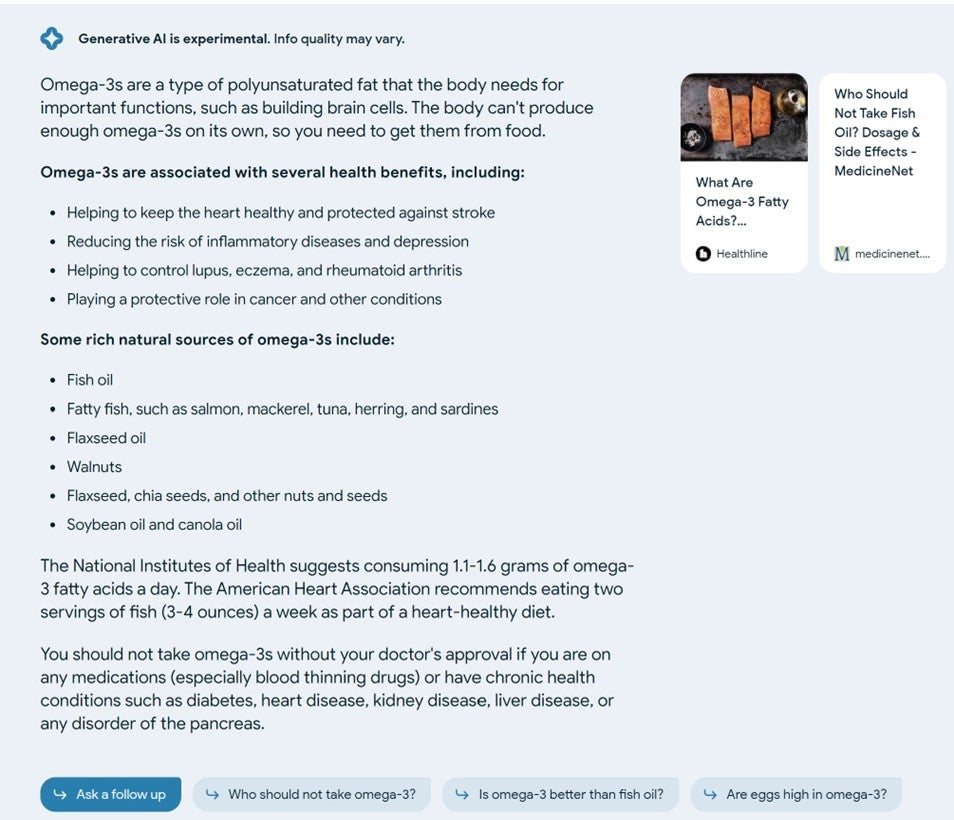
I like that it has the disclaimer at the end of the answer about consulting with your doctor before taking omega 3’s, especially if you have chronic health conditions. This answer is similar to one I would provide as a registered dietitian, but most reputable health websites would have offered a similar response.
To see how “personalized” AI can get when it comes to nutrition-related health recommendations, I decided to ask ChatGPT for recommendations on what I should eat to control blood sugar and lose weight. While its answers were not totally off the wall, it did recommend a fairly healthy 7-day meal plan, the answer the AI provided was very generic.
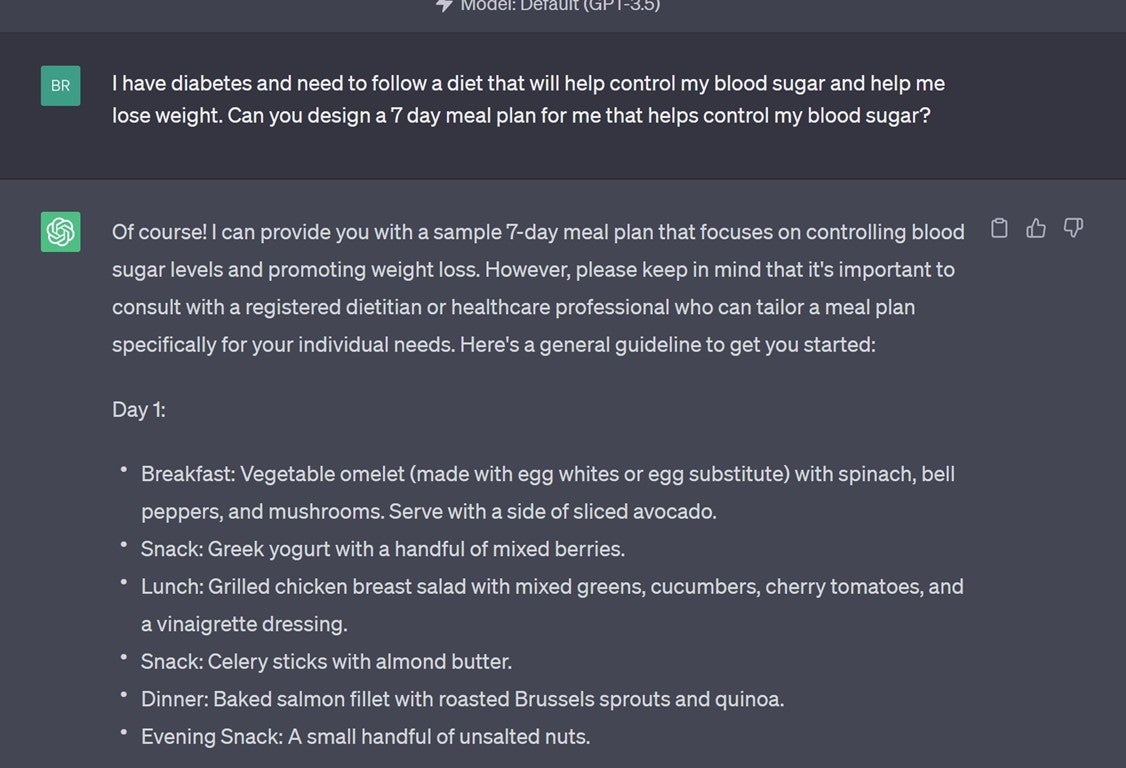
When it comes to blood sugar control and weight loss, diet plans should be highly personalized. Each individual needs a specific number of calories or carbohydrates based on their sex, age, current body weight, physical activity, medications, other health conditions, and current blood sugar readings.
While this is a fairly balanced meal plan, it is not personalized. It does not provide portion sizes to help you calculate the calories or the grams of carbs in each meal. I asked ChatGPT to provide the calorie ranges and it estimated that this meal plan would provide between 1200-1400 calories. For many people, this would be too low, even for weight loss.
For now, if you want a recommendation about what you should eat to manage medical conditions, it is best to see a registered dietitian who can assess your individual needs and make personalized recommendations.
Limitations of AI for Healthcare
While the future might be bright for AI and healthcare, there are currently many limitations to using it beyond simply gathering basic information about health-related topics. But always do more research beyond what the AI provides, as it has been known to make up information.
Recently, a lawyer used ChatGPT to prepare his case filing. The AI made up all of the cases that were cited in the filing. They seemed real at the time, but when the judge looked them up, they were all fake [2]. This lawyer is now facing charges for relying on AI without fact-checking.
The developers of AI call this phenomenon “hallucinations”. It makes up facts and even cites studies that do not exist. Therefore it is best to always double-check the information the AI provides against other sources.
Currently, AI lacks context and nuances of health information. It often is unable to interpret information in a broader context, such as considering a patient’s individual circumstances, cultural background, or personal preferences.
AI relies on the data it is given to make recommendations. If the data is incomplete, inaccurate, or biased, it will provide results that are also incomplete or inaccurate. It also does not generalize well to different populations. If it is given information that applies to one geographical region or a specific demographic group, it may not provide accurate recommendations for a different population or location.
When you input private information into the AI, it is not private. The companies that make AI are currently using user data to improve their product, which is why the programs are currently free to use. It is best not to enter any private health information into the AI since it is unclear how this information is being stored or utilized.
The Future of AI and Healthcare
For the future of AI and healthcare, there are still a lot of kinks to work out. The gathering of personal information raises ethical and legal concerns, including issues related to privacy, security, and informed consent. One of the primary issues that will need to be addressed before the widespread use of AI, will be protecting patient confidentiality and ensuring data security, especially when dealing with sensitive health information.
While the future is exciting for healthcare and AI, there are still many concerns that must be addressed.


