


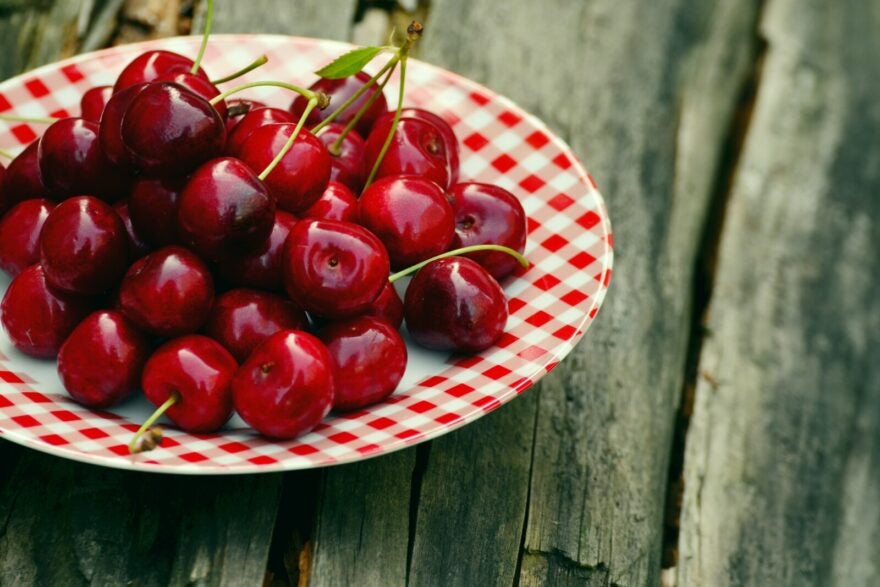
You’ve always been told to eat your colors, but red is definitely the color of the moment.
It’s only fitting that February is the American Heart Association’s Heart Health Month. It intertwines with the month of love in celebrating Valentine’s Day.
If you’re feeling in the spirit of all things red, add some red foods to your diet. Fruits and vegetables with red hues are brimming with antioxidants. In fact, all fruits and vegetables with deep ruby tones, including those that are purple and blue, have at least one type of powerful antioxidant.
Here are some red foods you will want to add to your diet, this month, and every month.
Cherries
 Cherries should be on your must-have list of red foods. Research has indicated that cherries improved sleep, decreased blood pressure, and decreased inflammation, which can improve your heart health.(1)
One cup of cherries is just shy of 100 calories with over 3 grams of fiber. Add fresh or frozen cherries to yogurt or overnight oats for a sweet treat with no added sugar. (2)
Beets
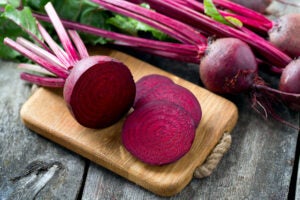
It should be no surprise that beets made the list of red foods you should have in your diet. Whether you’re pro-beet or anti-beet because you’ve never tried them, one thing’s for sure — they are good for your heart. Beets contain a substance called nitrate, which is the precursor compound for nitric oxide. Nitric oxide helps with blood vessel tone and may lower your blood pressure.(3) If you think you don’t like beets, skip the canned variety and head straight to the produce section. Roast fresh beets and serve with creamy plain Greek yogurt and pistachios. Better yet, you can grate beets like carrots and add them to a salad. There is also beet supplements that people use as well.
READ MORE: The Benefits of Beets: Are They Good For You?
Tomatoes
Tomatoes might be the most versatile red food you have in your kitchen. From sauce to salads, tomatoes are a staple ingredient in many dishes, and there’s never been a better time to embrace them.
Tomatoes get their red color from an antioxidant called lycopene, which Harvard Medical School indicates may help lower your risk of stroke (4). Lycopene is better absorbed when eaten with a source of fat, so add a healthy fat such as olive oil, avocados, or nuts to your tomatoes.(5)
Strawberries

Strawberries aren’t just popular in February when they’re covered in chocolate, but all year long. Strawberries are high in anthocyanins, the antioxidant that gives them their red color.(6)
They are also rich in vitamin C, which can help support your immune function. One cup of fresh strawberries provides more than the RDA of vitamin C for adult women and almost the full recommended amount for adult men. (7)
Apples
If there ever was a fruit that is available all year and always in season, it’s the apple. Red varieties include Red Delicious, Gala, Pink Lady, Braeburn, Fuji, and many others.
Apples contain both soluble and insoluble fiber, which is good news for your gut and may be one of the reasons why apples are considered the fruit that will “keep the doctor away.” Pectin is a soluble fiber in apples that may help lower cholesterol, which is excellent news for your heart health.(8)
Apples are a culinary chameleon, transforming into sweet and savory dishes alike. Sauté sliced apples until soft and serve alongside a roasted pork tenderloin or slice a sweet red apple and dip it into creamy nut butter for a healthy snack.
Red Bell Peppers
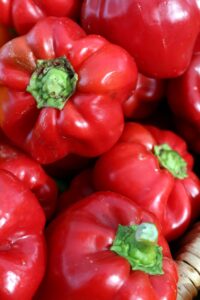 It might surprise you to know that a half-cup of sliced red bell peppers contains more vitamin C than a medium orange. (9) Red bell peppers are a versatile vegetable in cooking and there are many ways you can seamlessly add them to your next meal or snack.
Use red bell peppers as edible cups for your favorite version of stuffed peppers or chop and add them to your favorite rice dish. Slice red bell peppers thin and dip in a homemade yogurt ranch or hummus as a snack or to encourage your kids to eat more peppers.
Pomegranate
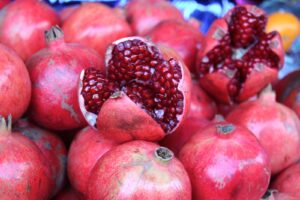 The pomegranate has been widely studied and has been shown to decrease inflammation, which can be present in various chronic conditions.(10) Adding just a small amount of this fruit to your daily diet may help you reap the nutritional benefits.
If dry January is spilling over to February, use pomegranate juice as an alternative to an alcoholic drink or simply to increase the antioxidants in your diet. You can also purchase pomegranate arils as a convenient addition to a salad or smoothie bowl.
READ MORE: Detox and Top 10 Detox Drinks
Watermelon
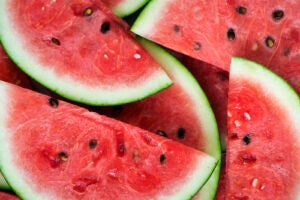 Did you know that watermelon is over 90% water? (11) That makes it a perfect choice for active adults who need to stay hydrated. It’s also rich in the amino acid, citrulline, and some evidence shows watermelon may be able to reduce muscle soreness after a workout. (12)
To add more watermelon to your meals, try making a watermelon salad with equally hydrating cucumbers and savory feta cheese. Add watermelon to a blender with strawberries for a nutritious and refreshing pink drink.
Raspberries
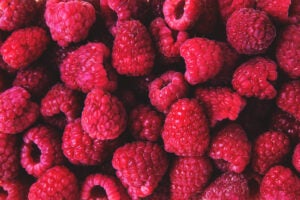 Raspberries rule when it comes to fiber — one cup gives you 8 grams! (13) That’s an impressive amount if you are increasing your fruits and vegetables with an intention of also eating your fiber. Research tells us that most adults only get around 16 grams of fiber daily, significantly lower than the recommended 25 grams/day for women and 38 grams/day for men.(14)
Fresh and frozen raspberries are equally nutritious choices. Add to smoothies, yogurt, or sprinkle fresh raspberries on your morning granola.
Radishes
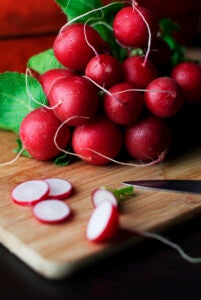 The radish is part of the Brassicaceae family, which also includes cabbage, broccoli, kale, and Brussels sprouts — that’s awesome company. Red radishes have anthocyanins, but all radishes and their leaves offer nutritional benefits. Try slicing radishes, eating them as a snack, and using them as a topper for chili or soups. For a more sophisticated flavor, roast radishes in olive oil for a heart-healthy side dish.
Seek out more red foods daily for a boost of antioxidants and nutrients in your diet.
References
1. Kelley, D. S., Adkins, Y., & Laugero, K. D. (2018). A review of the health benefits of cherries. Nutrients, 10(3), 368. https://doi.org/10.3390/nu10030368
2. USDA Food Database. Cherries, sweet, raw. https://fdc.nal.usda.gov/fdc-app.html#/food-details/171719/nutrients
3. Benjamim, C. J. R., Porto, A. A., Valenti, V. E., Sobrinho, A. C. D. S., Garner, D. M., Gualano, B., & Bueno Júnior, C. R. (2022). Nitrate derived from beetroot juice lowers blood pressure in patients with arterial hypertension: A systematic review and meta-Analysis. Frontiers in Nutrition, 9, 823039. https://doi.org/10.3389/fnut.2022.823039
4. Godman, H. (2012). Lycopene-rich tomatoes linked to lower stroke risk. Harvard Health Publishing. Harvard Medical School https://www.health.harvard.edu/blog/lycopene-rich-tomatoes-linked-to-lower-stroke-risk-201210105400
5. Arballo, J., Amengual, J., & Erdman, J. W., Jr (2021). Lycopene: A critical review of digestion, absorption, , metabolism, and excretion. Antioxidants (Basel, Switzerland), 10(3), 342. https://doi.org/10.3390/antiox10030342
6. Milosavljević, D. M., Maksimović, V. M., Milivojević, J. M., Nakarada, Đ. J., Mojović, M. D., & Dragišić Maksimović, J. J. (2022). Rich in phenolics-strong antioxidant fruit? Comparative study of 25 strawberry cultivars. Plants (Basel, Switzerland), 11(24), 3566. https://doi.org/10.3390/plants11243566
7. USDA Nutrient Database. Strawberries, raw. https://fdc.nal.usda.gov/fdc-app.html#/food-details/2344777/nutrients
8. Koutsos, A., Tuohy, K. M., & Lovegrove, J. A. (2015). Apples and cardiovascular health–is the gut microbiota a core consideration? Nutrients, 7(6), 3959–3998. https://doi.org/10.3390/nu7063959
9. NIH Vitamin C Fact Sheet. https://ods.od.nih.gov/factsheets/VitaminC-HealthProfessional/
10. Kandylis, P., & Kokkinomagoulos, E. (2020). Food applications and potential health benefits of pomegranate and its derivatives. Foods (Basel, Switzerland), 9(2), 122. https://doi.org/10.3390/foods9020122
11. USDA Nutrient Database. Watermelon, raw. https://fdc.nal.usda.gov/fdc-app.html#/food-details/167765/nutrients
12. Tarazona-Díaz, M. P., Alacid, F., Carrasco, M., Martínez, I., & Aguayo, E. (2013). Watermelon juice: potential functional drink for sore muscle relief in athletes. Journal of Agricultural and Food Chemistry, 61(31), 7522–7528. https://doi.org/10.1021/jf400964r
13. USDA Nutrient Database. Raspberries, raw. https://fdc.nal.usda.gov/fdc-app.html#/food-details/167755/nutrients
14. Quagliani, D., & Felt-Gunderson, P. (2016). Closing america’s fiber intake gap: Communication strategies from a food and fiber summit. American Journal of Lifestyle Medicine, 11(1), 80–85. https://doi.org/10.1177/1559827615588079

