



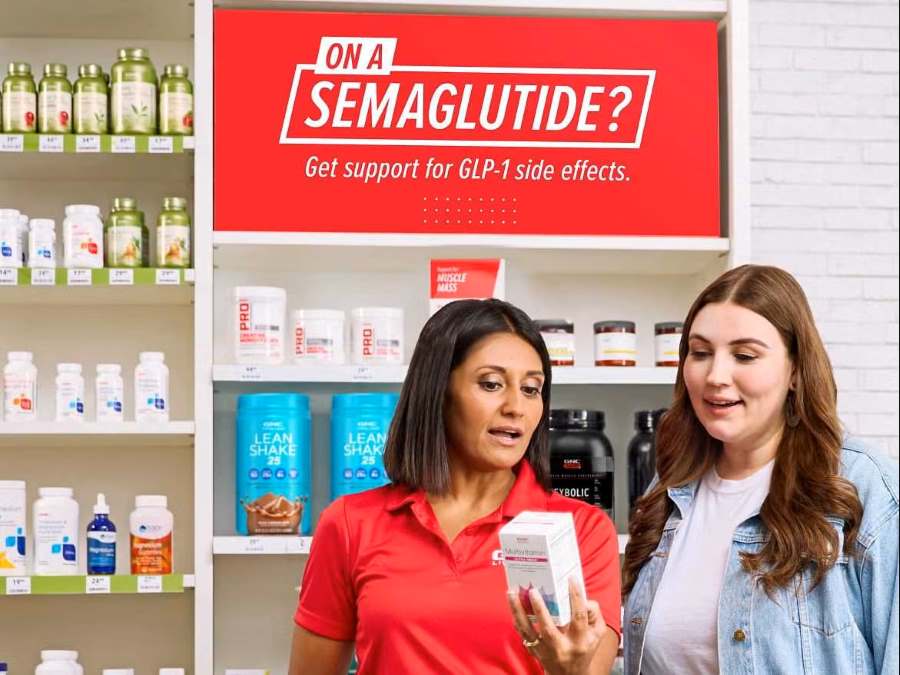
As a nutrition researcher, I often see trends leading faster than science can catch up and the quick advances of weight loss drugs have been studied with little investigation of nutritional concerns. With the rapid growth and popularity of glucagon-like-peptide-1 (GLP-1) for medical weight loss and the evolving science, GNC set out to better understand nutritionally what’s happening. There’s a lot we are still learning about GLP-1 medications, but they have taken the obesity industry by storm.
We know GLP-1 slows down the emptying of food from the stomach, helps manage blood sugars, and reduces appetite, all common sense knowing it will lead to reduced calorie intakes. We can make highly educated science-backed hypotheses between how the medication works and previous massive and rapid weight loss research (think weight loss surgery and the Biggest Loser), but GLP-1 specific nutrition science will take some time to catch up. That’s why we did some grassroots research to help fill those gaps in scientific knowledge. GNC completed the first-ever clinical study investigating specific nutritional intake while using GLP-1 outside a lab environment.
Read the peer-reviewed published paper: Frontiers | Investigating nutrient intake during use of glucagon-like peptide-1 receptor agonist: a cross-sectional study
Key Takeaways:
- Nutrition research in conjunction with GLP-1 drugs is in its infancy
- We conducted a clinical study to better understand nutritional intake while using GLP-1 to inform education and product development
- People using a GLP-1 consume too many calories, fat, and sodium
- People using a GLP-1 are not meeting the daily needs for fiber, calcium, iron, magnesium, potassium, choline, vitamin A, C, D, and E
- People using GLP-1s did not meet the daily servings for fruits, vegetables, whole grains, or dairy
- People using a GLP-1 are missing out on almost 40 grams of protein daily based on individual calculated needs!
What Inspired this Research?
As a dietitian I understand weight loss is so much more than the number on a scale and our team is passionate about healthy, durable weight loss. We analyzed the available scientific evidence to understand how GNC can best support customers using a GLP-1 based on research.
Since research is just emerging with GLP-1 and there’s so much we don’t know yet, data from weight loss surgery, previous weight loss drugs like Orlistat, and traditional weight loss interventions helped guide us. A highly critical and comprehensive analysis of this data allowed us to guide customers with our initial GLP-1 support. However, as these medications continue to grow, our team wanted data from current GLP-1 users to create better customized education, solutions, and formulas.
There’s basic information we know about how these medications work, such as slowing down your digestion which may cause nausea, vomiting, or diarrhea. We also know there are ingredients and supplements known to support these side effects. But what we didn’t know is exactly what’s happening nutritionally while using these medications, meaning are diets truly different than the average American diet, are they really a low-calorie diet, are people still able to achieve a healthy diet and adequate vitamin and mineral intake? This is such an exciting area and there is so much to learn. So GNC led the way and conducted a clinical study, the first of its kind, to help answer some of these questions. This is a big deal, as having a peer-reviewed publication is the highest gold-standard in research.
What Did We Study
We recruited people who have been taking a GLP-1 drug for at least one month to participate in a survey questionnaire and record everything they eat and drink, including portion sizes and supplements, for 3 days. To standardize the approach, we asked participants to record their food for the first three days after their weekly injection since there isn’t a lot of evidence to inform how food intake changes over the course of treatment. A total of 69 people enrolled in our study with an average age of 50 years old and majority of them had been using GLP-1 for more than a year.
After everyone completed the survey and food record, the average nutrient intake was compared to dietary reference intakes (DRI). The DRIs are based on years of scientific evidence and expert consensus on how many grams, milligrams, micrograms, etc. are needed of each nutrient daily. These DRIs are designed to promote health and prevent chronic disease and toxicities. A lot of complicated statistical analyses were run on various measures to help find if there were any significant outcomes.
What we found
As a Registered Dietitian Nutritionist, what we found when analyzing diets didn’t surprise me too much, but a few results did! Our findings will really help provide better advice and more targeted recommendations.
Too Many Calories and Not the Right Kind
Key Takeaways:
- Too many calories
- Too much fat from calories
- Not enough protein for muscle mass preservation
- Too little fiber-rich carbohydrates
Overall, we found people are still consuming too many calories for weight loss. Experts provide current calorie goal range of 1200-1500 calories per day for females and 1500-1800 calories for males. We found participants averaged almost 2,000 calories per day, well above the calorie recommendations. Something we do not know is how many calories they were consuming before starting their GLP-1. They could have been consuming significantly more, meaning 2,000 is a much lower calorie intake for them. However, based on expert recommendations, too many calories are consumed from this group.
Second, the types of calories being consumed were not the right portions of carbohydrates, protein, and fat. Interestingly, our findings were in line with other research studies looking at the percentage of calories from carbohydrates, protein, and fat for one day of food intake while in a research lab.
Our sample of participants did not consume enough carbohydrates and too much fat. Fiber intake was also significantly below the daily goal. This is important because fiber helps with digestive health and common side effects are constipation. People using GLP-1 drugs should lower their fat intake and increase fiber intake to help with gastric emptying. GLP-1 slows this process down and so does fat, potentially causing more side effects like nausea.
Fiber will also help push things through the gastrointestinal tract. Based on the percentage of calories, they were meeting the lower end of the range for protein at 18%. However, this goal does not take into consideration the higher protein needs for weight loss. Protein intake was significantly under individual needs to meet the higher protein needs on a low-calorie diet during weight loss. To preserve lean mass during weight loss, higher protein intake is recommended. For reference, based on body weight, our group of GLP-1 users should be eating around 120 grams of protein per day but were only eating 77 grams of protein per day. That’s a significant gap in protein intake.
Preserving muscle mass is a key indicator for long-term weight management. What was really interesting was based on the survey responses before recording their food intake, they believe they are eating less protein than they actually are, so it shows more emphasis needs to be placed on protein intake. Getting 120 grams of protein from food can be hard, especially if your appetite is lower. That’s where very practical recommendations of adding in a protein supplement can go a long way to boosting daily protein intake to support lean mass.
Macronutrients
Too Much
- Calories
- Fat
- Saturated Fat
Not Enough
- Fiber
- Protein(g/kg)
Food Groups
Too Much
- Refined Grains
Not Enough
- Fruits
- Vegetables
- Whole Grains
Micronutrients – Tiny but Mighty and Missing
Often when going on a diet, micronutrients, vitamins and mineral intake, are an afterthought. A large emphasis is placed on calories and protein intake; however, vitamins and minerals play essential roles in our health. When analyzing the data, we compared the average intake of vitamins and minerals and compared them to their respective daily needs (remember those DRIs), to determine if people using a GLP-1 are getting enough.
Now you might be questioning, asking how can you know this… statistics! A fancy calculation takes all the averages from the group and determines a 95% confidence interval. This means that we are 95% confident that most of the reported nutrient intake was within a certain range and was significantly under or over the DRI.
Compared to the DRIs, people using a GLP-1 meet their daily B-vitamin needs, and a few others from food alone. However, there were significant gaps in calcium, iron, magnesium, potassium, vitamins A, C, E, and D. This is where a multivitamin supplement becomes crucial to help meet your daily vitamin and mineral needs while using a GLP-1 drug.
It’s nearly impossible to get all the daily micronutrients at their recommended dose and reducing your food intake makes it even more challenging. Even in the subgroup who used supplements, some nutrients fell short of their daily needs. Stay tuned for those results!
Micronutrients
Too Much
- Sodium
Not Enough
- Calcium
- Iron
- Magnesium
- Potassium
- Vitamin A
- Vitamin C
- Vitamin D
- Vitamin E
Balancing Plates and Food Group Servings
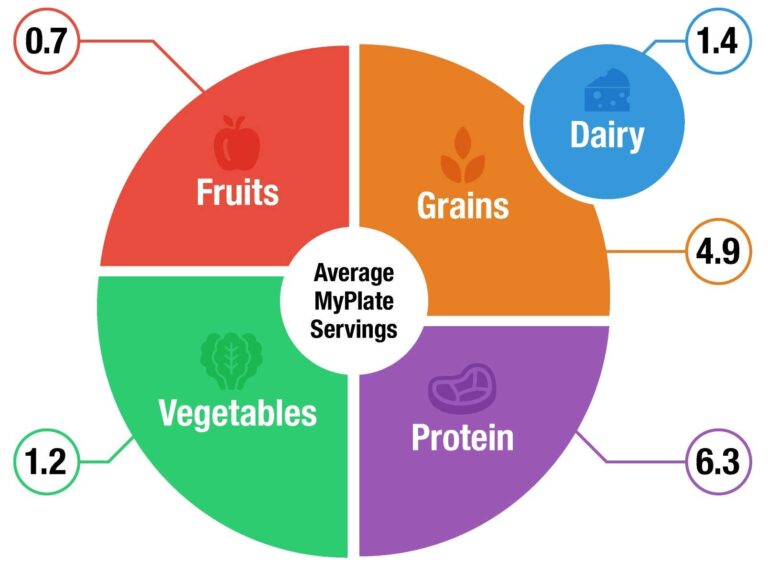
Another area we explored was if GLP-1 users are meeting the daily food group recommendations. MyPlate is a visual guide for building balanced meals, where half your plate should be filled with fruits and vegetables, alongside ¼ grains, ¼ protein, and a serving of dairy for well-rounded balanced meal.
Many participants in our study reported eating more fruits and vegetables since starting GLP-1—an encouraging shift! However, despite these improvements, they still fall short of the recommended daily servings, leaving gaps in essential vitamins, minerals, and fiber. This further highlights an important opportunity that even with positive dietary changes, nutritional support remains crucial to ensure GLP-1 users get the nutrients they need for optimal health.
Here’s how their plates stacked up:
Recommendations Based on Evidence
With our findings, and previous understanding of the science of weight loss, you can have confidence in our GLP-1 Support wall recommendations. Here are some quick tips on how to help fill these nutritional gaps if you’re using a GLP-1.
Recommendations
- Help meet your daily nutrient needs with daily multivitamins
- Add fiber and reduce fat foods to help with some side effects. You can even incorporate a fiber supplement to help meet the daily goal
- Choose your favorite protein supplement to incorporate into your routine to help reach higher protein needs to help preserve lean mass
- Select other muscle supporting supplements like tried-and-true Creatine or HMB and combine with resistance training – this can help preserve muscle and help your metabolic rate!
Bonus, here are two fun ideas for supplements that you can try:
- If you’re feeling a pill fatigue, GNC’s multi powder is delicious and has foundational vitamins and minerals, fiber, and 5 grams of protein! Trifecta!
- Add in some greens! Amplified Greens of Vital Greens can be a great way to get 1.2 cups equivalent of fruits and veggies. Add a scoop of creatine and HMB. HMB can be a little bitter and the fruity flavors help mask this taste.
In conclusion, we found several nutritional gaps while using a GLP-1 drug. This research is important because it’s the first clinical study to provide specific evidence-based data to support users on a GLP-1 to optimize health. Key takeaways for those on a GLP-1 are increasing protein and fiber intake and taking multivitamins to meet nutrient gaps. There’s still a lot for us to learn and GNC is here to support your weight loss journey.

